

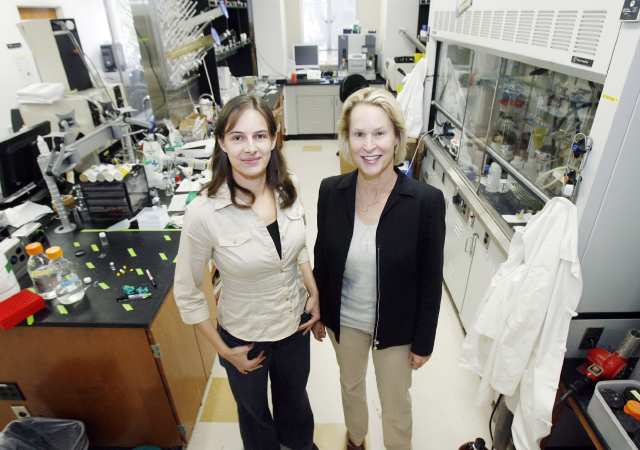
The vehicle for all of life’s variety and complexity has found a new driver in La Cañada’s Frances Arnold.
In her laboratories at Caltech, Arnold is harnessing the evolutionary process to create new proteins and enzymes that have the potential to wean the world off of fossil fuels, advance doctors’ understanding of disease and addiction and solve other pressing social problems.
Like an animal breeder working at the molecular level, Arnold manages the growth and reproduction of microscopic life-forms to reshape them for practical scientific purposes — a yeast that could effectively convert plants into jet fuel or plastics, for instance, or a microbe with the power to help map the human brain.
For her pioneering work in the emerging field of “directed evolution,” Arnold was earlier this year awarded the prestigious Draper Prize, an honor established by the National Academy of Engineering that carries the scientific clout of a Nobel Prize. Arnold shared that award — and split its $500,000 in prize money — with Willem Stemmer, who has used directed evolution to develop advanced biopharmaceuticals. In previous years, Draper Prizes have gone to inventers of the global positioning system (GPS), architects of the Internet and developers of the turbojet engine.
